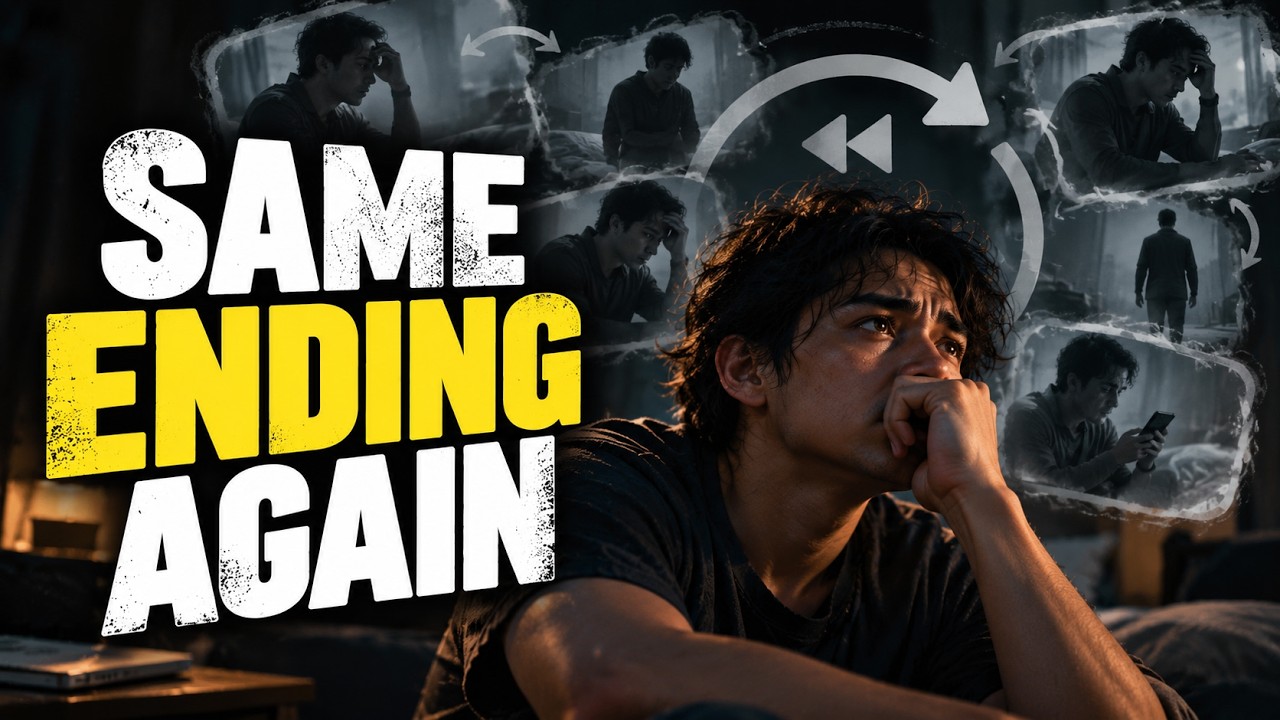
It was one sentence, said on Tuesday in the middle of an ordinary conversation. For half a second their face changed. Maybe it meant nothing, but you saw it, and since then you have gone back to that moment more times than you can count. In the car, at your desk, halfway through talking to someone else. Every time you replay it their expression gets a little colder and your words sound a little more foolish, and it still ends the same way.
If you keep replaying conversations in your head and cannot make it stop, you are not unusual and you are not broken. There is a man in Scripture who was stuck in exactly this, and what he did about it is more practical than anything you have been told so far. He had to do it more than once, which turns out to be the encouraging part.
In This Article
- The Conversations That Only Happen in Your Head
- Why Replaying It Feels Like the Responsible Thing
- The Belief Hiding Underneath the Loop
- A Man Stuck in His Own Replays in Psalm 42
- Talking Back Instead of Listening
- He Had to Say It Three Times
- The Word Almost Everyone Reads Past
- One Question That Separates Thinking From Looping
- What to Do When the Replay Starts Again
- When It Is More Than Overthinking
The Conversations That Only Happen in Your Head
It is rarely just the one. There is the email you read again after it had already gone. There is the thing you said at a dinner table three years ago that still makes your face go hot when it surfaces. There is the argument you have in the shower with somebody who is not there, where you finally land the perfect line you could not find at the time.
You rewrite what you should have said. You read a three word reply and build a whole story on top of it. Some of the most draining conversations of your life never actually took place. They happened in your head, over and over, with you playing both parts. From the outside nobody can tell. You are nodding along in the meeting, and somewhere behind your eyes the tape is still running.
Why Replaying It Feels Like the Responsible Thing
What makes this so hard to stop is that it does not feel like a problem. It feels like conscientiousness. If you go over it one more time, maybe you will finally understand what happened, how upset they really are, and what you ought to do about it. So stopping feels careless, as if you would be letting yourself off the hook.
But ask yourself one honest question. You have replayed it forty times. When did the replay last tell you anything new?
Real thinking goes somewhere. When you are working on an actual problem, each pass brings something you did not have before, and then it ends because you decide and act. A replay has the same scene, the same people and the same words every time. The only thing that changes is how much it hurts. Your body reacts to each rerun as though it were happening again, so you are not reviewing something that happened once. You are living through it forty times. Thirty seconds on Tuesday has quietly eaten hours of your week, and that is a loop, not processing.
The Belief Hiding Underneath the Loop
For many people there is a belief under all this that they would never say out loud. If I keep thinking about it, I will be safe. If I rehearse every way this could go wrong, then when it does, at least I will have seen it coming.
Overthinking becomes a kind of bodyguard. The trouble is that it never clocks off, so you never rest, and it is so busy watching the door that you miss the people who are actually in the room with you. It has never once prevented the bad thing from happening. All it has done is make sure you suffered it in advance. If this is what keeps you awake, our piece on Bible truths for nights when anxiety will not let you sleep sits well alongside this one.
“When anxiety overwhelms me, Your consolation delights my soul.”Psalm 94:19
A Man Stuck in His Own Replays in Psalm 42
Psalm 42 was written by someone a long way from home. Its heading ties it to the sons of Korah, the families who served at the temple, and the writer now finds himself far to the north near the mountains, cut off from the place he loved. Listen to what is going on in his head.
“My tears have been my food both day and night, while men ask me all day long, “Where is your God?””Psalm 42:3
All day long. Perhaps people really did say it to him every single day. Perhaps someone said it once and he could not stop hearing it. Anyone who has replayed a remark knows how one sentence can become a whole day’s soundtrack. Then he turns to the past.
“These things come to mind as I pour out my soul: how I walked with the multitude, leading the festive procession to the house of God with shouts of joy and praise.”Psalm 42:4
He is replaying what people said about him and replaying the life he used to have. It is the same machinery you know from Tuesday, running in a man who loved God and led worship for a living.
Talking Back Instead of Listening
Then, right in the middle of it, he does something different. He turns and speaks to himself.
“Why are you downcast, O my soul? Why the unease within me? Put your hope in God, for I will yet praise Him for the salvation of His presence.”Psalm 42:5
He is not addressing the people taunting him, and for that moment he is not even addressing God. He is speaking to his own soul. He stops letting his mind talk at him and starts answering it.
Martyn Lloyd-Jones, a London physician who became a preacher, wrote about this psalm in the last century. His point was that a great deal of our unhappiness comes from listening to ourselves when we ought to be talking to ourselves. Most of us only listen. We assume a thought must be true because it is loud. The psalmist questions it. Why are you like this, soul? Then he tells it what is true: hope in God, praise is coming again.
He Had to Say It Three Times
The psalm does not end on that high note. A few verses later he is back under it.
“Deep calls to deep in the roar of Your waterfalls; all Your breakers and waves have rolled over me.”Psalm 42:7
The taunt comes back too, like something crushing his bones, and so he has to say the same words again at the end of the psalm. Then in the very next psalm, which many readers believe was first part of the same song, he says it a third time.
“Why are you downcast, O my soul? Why the unease within me? Put your hope in God, for I will yet praise Him, my Savior and my God.”Psalm 43:5
He did not win once and move on. The thoughts returned and he answered them again, and the psalm never pretends his mind went quiet. So if the replay starts up again after you have prayed about it, you have not failed. You are standing exactly where he stood. The aim was never a silent mind. The aim is deciding who gets the last word.
The Word Almost Everyone Reads Past
Right after that first refrain there is a small line that is easy to skim. He says his soul is cast down within him, and therefore he remembers God, from the land of the Jordan and the peaks of Hermon, wherever he happens to be standing.
Therefore. He does not stop thinking, because nobody can. He says, in effect, because I am low, I am going to remember something else. He is still replaying. He has just changed the tape.
Most advice about overthinking tells you to empty your mind, and you have tried that. You tell yourself not to think about it and it becomes the only thing you can think about. You cannot empty your mind, but you can choose what you hand it to hold. The time God carried you before. The prayer He answered that you forgot to thank Him for. The morning you did not expect to get through, and did. If your thoughts tend to run toward the future rather than the past, how to give your worries to God and actually rest takes the same idea forward.
One Question That Separates Thinking From Looping
When the replay starts, ask this: is there anything I can learn or do about this, right now?
If the answer is yes, do it. If you really did hurt someone, the remedy is not more thinking. It is going to them.
“So if you are offering your gift at the altar and there remember that your brother has something against you, leave your gift there before the altar. First go and be reconciled to your brother; then come and offer your gift.”Matthew 5:23-24
Jesus says go, not rehearse. Say it once and plainly: I think what I said on Tuesday came out wrong, and I am sorry. Then let their answer be their answer. If the guilt hangs on after you have made it right, our article on why you cannot forgive yourself even though God did speaks to that.
But if there is nothing new to learn and nothing left to do, you are no longer thinking. You are looping. When you ask the question honestly, the answer is usually no. They went home and made dinner. You are the only one still standing in Tuesday.
What to Do When the Replay Starts Again
First, name it. That is the replay again. Giving it a name puts a little distance between you and it.
Then answer it, out loud if you can, even under your breath. Why are you cast down, soul? There is nothing new here. Tell it what is true: I am not the worst thing I have ever said, God is not finished with me, and I will praise Him again.
If it is still spinning, write it down once. Thoughts that seem enormous in your head often look much smaller in ink. After that, tell one person you trust. Very often they will say they did not even notice. And use your hands. Walk around the block or wash the dishes. Your body got pulled into this loop, and your body can help pull you back out of it. None of this works once and forever. It works the way it worked for the psalmist, again and again.
When It Is More Than Overthinking
For some readers this goes beyond replaying conversations. If your thoughts feel intrusive, as though they come from outside you and will not leave, or you feel you must repeat certain checks or actions to make the fear subside, or worry has taken over your work, your sleep or the people you love, or you are having panic attacks, that is not a lack of faith. It can be an anxiety disorder or obsessive compulsive disorder, and both are treatable. Please talk to your doctor or a licensed counselor. Getting help is not the opposite of trusting God, and it can be one of the ways He answers. Our piece asking whether depression is a lack of faith covers the same ground for low mood.
If your thoughts have turned toward hurting yourself, call or text 988, the Suicide and Crisis Lifeline in the United States. Someone answers at any hour.
The psalmist never got a quiet mind out of Psalm 42. What he got was the habit of answering it. Pick the one conversation you have replayed most this week. If there is something left to do, go and do it once. If there is nothing left, then the next time it starts, say his words out loud and give your mind something better to hold: why are you downcast, O my soul? Put your hope in God. You may have to say it again tomorrow, and that is fine.